360 vs 3D Virtual Tour: What Is the Difference and Which Is Better?
360-degree tours and 3D virtual tours are often confused, but they offer fundamentally different experiences. This article explains the difference, covers the pros and cons of each, and helps you decide which is right for your real estate use case.
What is a 360-degree virtual tour?
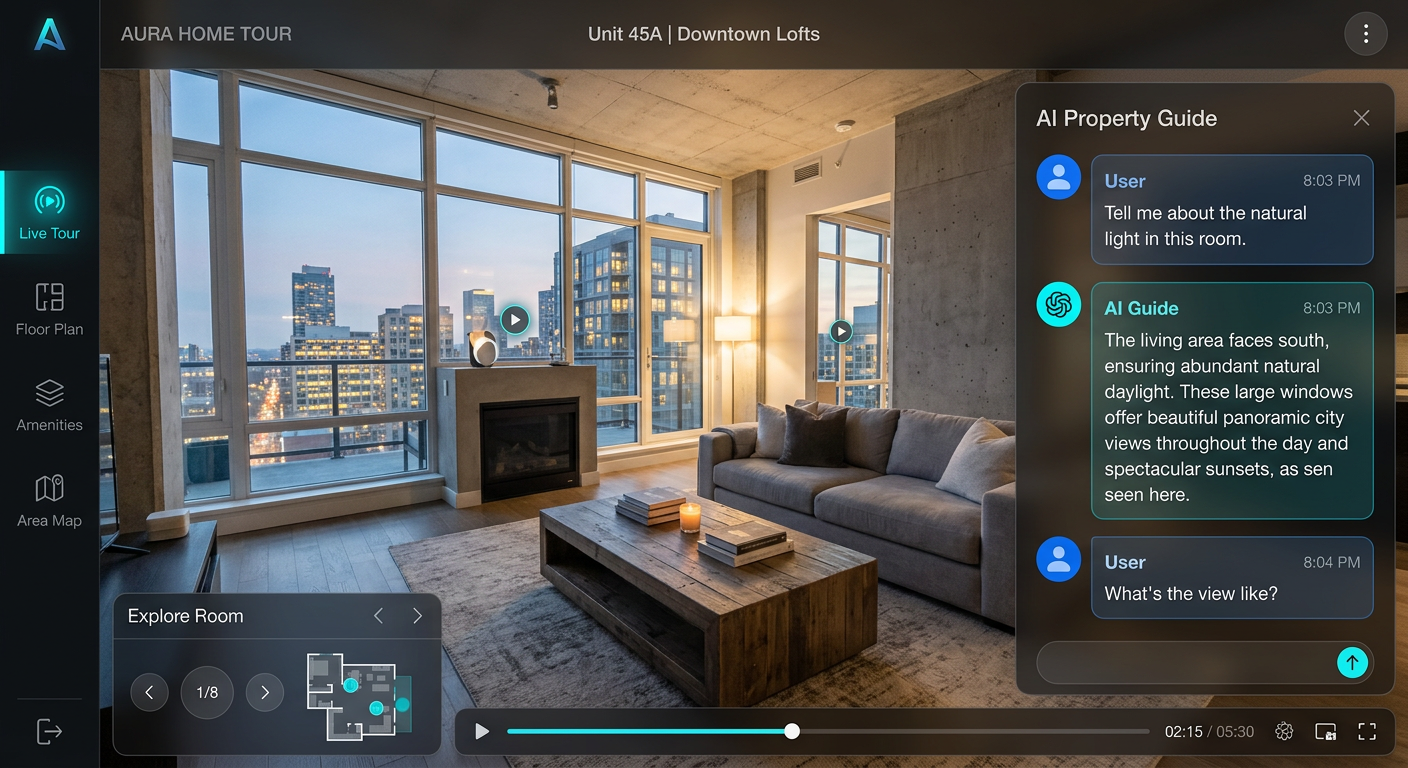
A 360-degree virtual tour is made from panoramic photos stitched together. The viewer stands at a fixed point and can look around in all directions — up, down, left, right — but cannot move through the space. To go to another room, they click a hotspot that jumps them to a new fixed point.
360 tours are relatively inexpensive to produce and work well for showing individual rooms. However, they do not convey spatial layout or the flow between rooms.
What is a 3D virtual tour?
A 3D virtual tour is a navigable digital model of a property. The viewer can move through the space more freely — walking from room to room, looking at different angles, and getting a sense of how the property flows. It provides a stronger sense of layout, proportions, and spatial relationships.
Key differences
- Movement: 360 tours jump between fixed points. 3D tours let you move through the space continuously.
- Spatial understanding: 360 shows individual rooms. 3D shows how rooms connect and the overall layout.
- Production cost: 360 tours are cheaper to produce. 3D tours require more specialized capture and processing.
- Immersion: 3D tours feel more like walking through a property. 360 tours feel more like looking at panoramic photos.
Which is better for real estate?
It depends on your goal. If you need to show individual rooms quickly and inexpensively, 360 tours are sufficient. If you want buyers to understand the layout, flow, and proportions of a property — especially for larger properties or remote buyers — a 3D tour provides significantly more value.
For most real estate sales use cases, the goal is not just to show the property but to engage the buyer. Both 360 and 3D tours are passive experiences. The buyer navigates alone, with no one to answer questions or guide them.
Where AI changes both formats
AI-guided tours work with both 360 and 3D content. The AI guide (Shivangi, in Augnix Guide) leads the buyer through the tour, answers questions, and tailors the experience. This addresses the biggest limitation of both formats: the lack of interaction and guidance.
Coming Soon:Augnix Live — which adds immersive, navigable 3D environments to the AI-guided tour — is in development. Coming Soon.
Where Augnix Guide fits
Augnix Guide adds the conversational layer that both 360 and 3D tours lack. Whether your property content is panoramic or 3D, Augnix Guide pairs it with an AI guide who leads buyers through the experience interactively. The format of the underlying content matters less than the quality of the guided experience.
Frequently asked questions
Is a 3D virtual tour better than a 360 tour?expand_more
For showing layout and spatial flow, yes — a 3D tour is more immersive. For quickly showing individual rooms on a budget, a 360 tour may be sufficient. The best choice depends on your property, budget, and buyer expectations.
Can I add an AI guide to a 360 tour?expand_more
Yes. Augnix Guide can work with 360-degree content. The AI guide leads the buyer through the tour and answers questions, regardless of whether the underlying content is panoramic or 3D.
Do buyers need a VR headset for a 3D virtual tour?expand_more
No. Most modern 3D virtual tours work in a standard web browser on laptop or mobile. Augnix Guide works the same way — buyers open a link on any device.
Related resources
Explore Augnix Guide
Experience an AI-Guided Property Tour with Shivangi.