Virtual Tour vs AI-Guided Property Tour: What’s the Difference?
Virtual tours and AI-guided property tours are often mentioned in the same breath, but they offer fundamentally different experiences. This article compares 360 tours, 3D tours, video walkthroughs, and AI-guided tours so you can decide which fits your property sales process.
The four main types of virtual property experience
When people say “virtual tour,” they might mean any of four different things. Understanding the difference matters because each format serves a different purpose in the property sales journey.
- 360 tour: Panoramic photos stitched together. The viewer looks around from fixed points but cannot move freely through the space.
- 3D tour: A navigable digital model of the property. The viewer can move through the space, getting a better sense of layout and proportions.
- Video walkthrough: A pre-recorded video that walks through the property on a fixed path. The viewer watches but cannot interact or change direction.
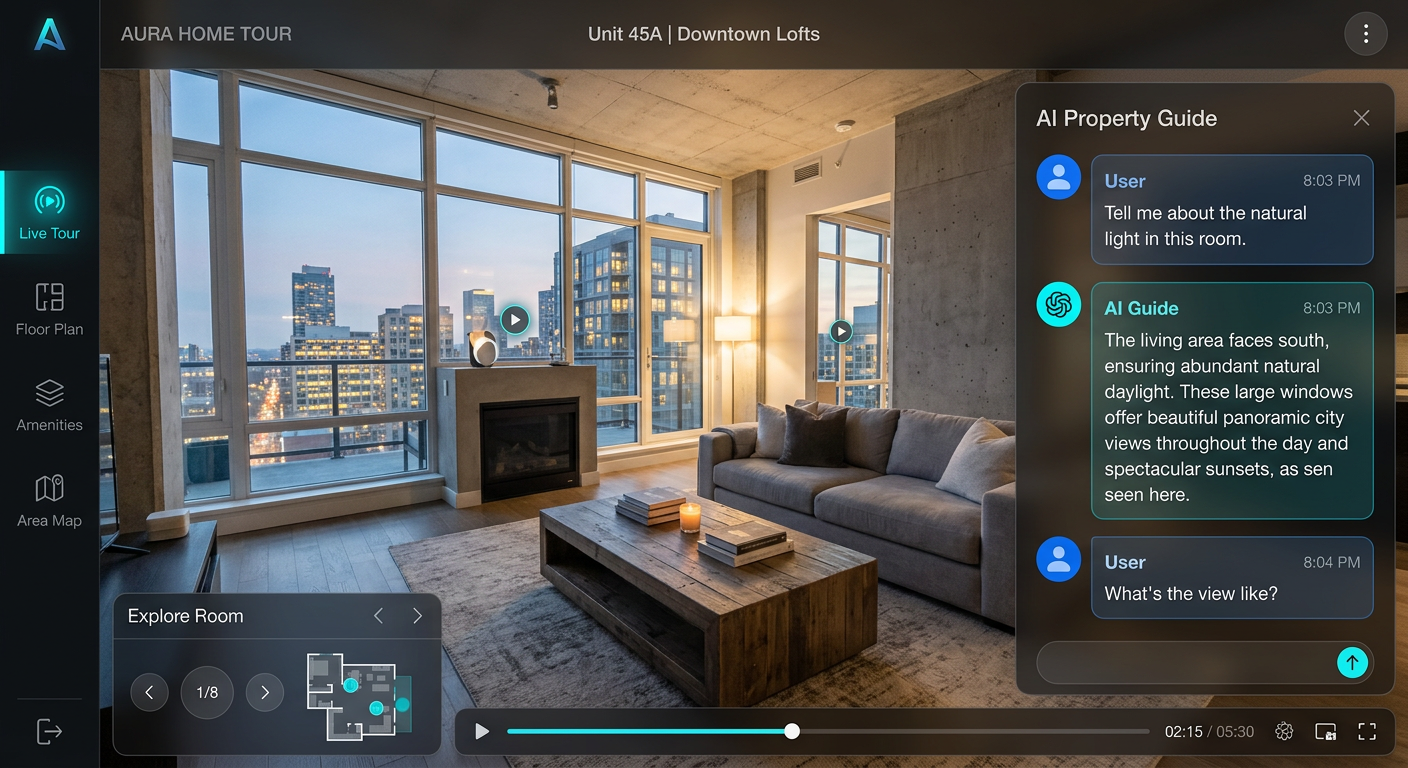
- AI-guided property tour: An interactive tour where an AI guide leads the viewer through the property, answers questions in real time, and adapts the experience to the viewer’s interests.
360 tour: What it is and where it helps
A 360 tour is made from panoramic photos. The viewer stands at a fixed point and can look in any direction but cannot walk through the space. To move to another room, they click a hotspot that jumps them to a new fixed point.
360 tours are relatively inexpensive to produce and work well for quickly showing individual rooms. However, they do not convey spatial layout, the flow between rooms, or how the property feels as a whole.
3D tour: What it is and where it helps
A 3D tour is a navigable digital model. The viewer can move through the space more freely, getting a stronger sense of layout, proportions, and how rooms connect. It provides a more immersive experience than a 360 tour.
However, a 3D tour is still a passive, self-guided experience. The buyer navigates alone with no one to answer questions or highlight features.
Video walkthrough: What it is and where it helps
A video walkthrough is a pre-recorded video that takes the viewer through the property on a fixed path. It is easy to produce and share, and it gives a sense of the property’s flow.
But a video is passive. The viewer cannot ask questions, request to see a specific room again, or change the order of the presentation. Every viewer sees the same video in the same sequence.
AI-guided property tour: What it is and how it differs
An AI-guided property tour combines a virtual property experience with a conversational AI Property Guide. The guide leads the buyer through the property, answers questions in real time, and adapts the tour to the buyer’s interests.
Unlike a 360 tour, 3D tour, or video walkthrough, the buyer is not navigating alone. The experience is conversational — the buyer asks, the guide responds, and the tour adapts. This makes it closer to a physical visit with a human agent than to a passive viewing.
Key differences at a glance
- Interaction: 360, 3D, and video tours are passive. An AI-guided tour is interactive — the buyer talks and the guide responds.
- Personalization: 360, 3D, and video tours show the same content to every viewer. An AI-guided tour adapts to each buyer’s interests.
- Guidance: 360, 3D, and video tours have no guide. An AI-guided tour has a guide who accompanies the buyer through the experience.
- After the tour: 360, 3D, and video tours end with no context for the sales team. An AI-guided tour can capture buyer context to support the next sales step.
Which experience is right for your property sales process?
If you need to show individual rooms quickly and inexpensively, a 360 tour may be sufficient. If you want buyers to understand layout and spatial flow, a 3D tour provides more value. If you need a simple, shareable overview, a video walkthrough works.
If you want buyers to engage — to ask questions, explore based on their interests, and arrive at a physical visit already informed — an AI-guided property tour offers a different level of engagement. It does not replace the other formats; it adds the conversational layer they lack.
For most real estate sales processes, the goal is not just to show the property but to help the buyer understand it. An AI-guided tour is designed for that goal.
Frequently asked questions
What is the difference between a virtual tour and an AI-guided property tour?expand_more
A traditional virtual tour (360, 3D, or video) is a passive experience — the buyer navigates alone with no interaction. An AI-guided property tour adds a conversational AI guide who leads the buyer through the property, answers questions in real time, and adapts the experience to the buyer’s interests.
Can I add an AI guide to an existing 360 or 3D tour?expand_more
Yes. Augnix Guide is designed to add a conversational guide layer to your existing property content. You do not need to rebuild your tour from scratch.
Is an AI-guided tour better than a 3D tour?expand_more
They serve different purposes. A 3D tour provides spatial context — layout, proportions, and flow. An AI-guided tour adds conversation and guidance on top of that spatial content. The two work together: the 3D content provides the space, and the AI guide provides the experience.
Do buyers need special equipment for an AI-guided property tour?expand_more
No. With Augnix Guide, buyers open a link on their laptop, phone, or TV. No app download or VR headset is required.
Related resources
Explore Augnix Guide
Experience an AI-Guided Property Tour with Shivangi.