Five Ways Your Customer’s Number Leaves Your Phone Before the Site Visit
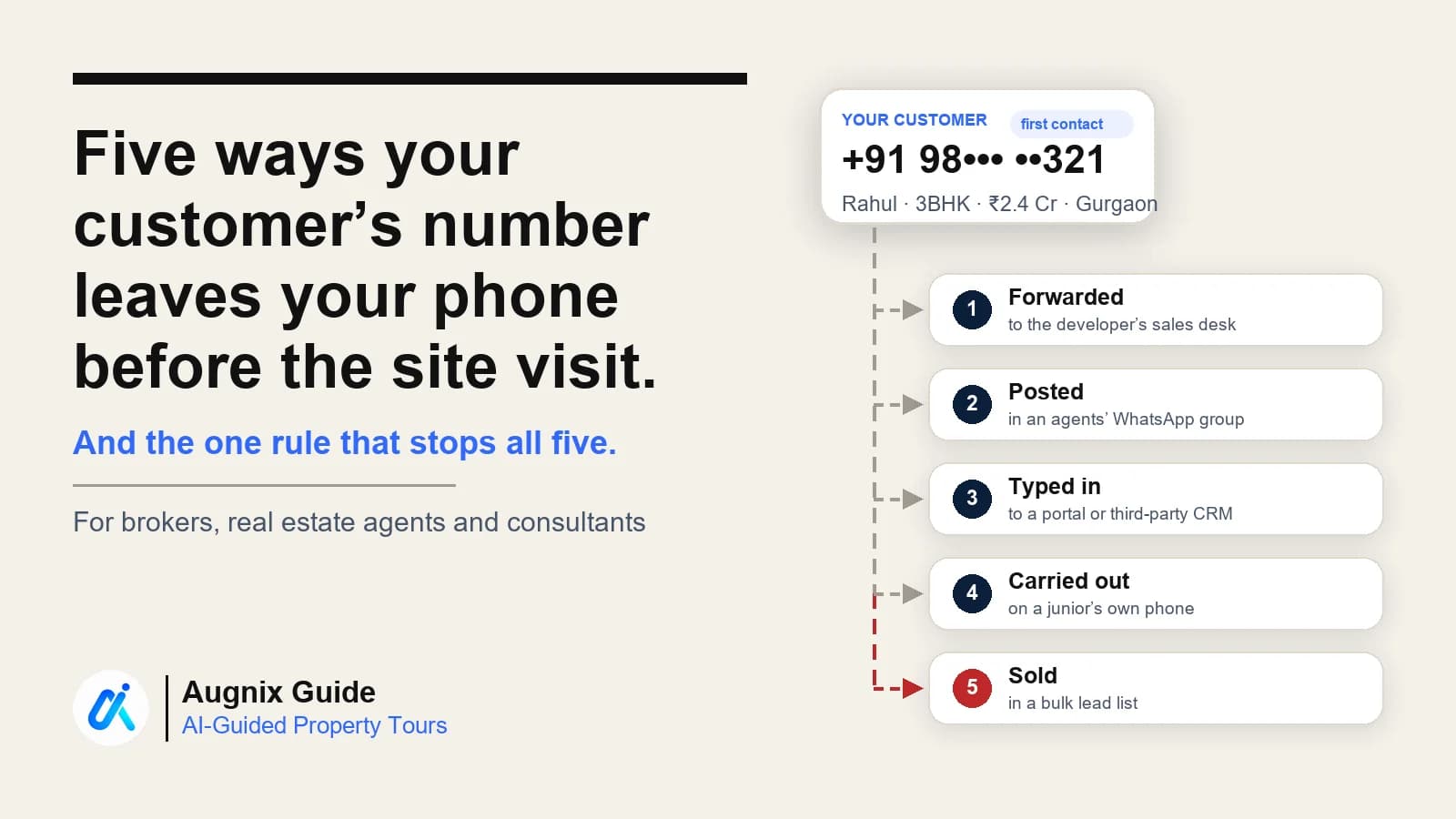
Count the ways a buyer’s mobile number can leave your phone between the first enquiry and the site visit. We counted five. Each one is a habit, not a hack, and each ends the same way: a developer’s sales desk, a competitor or an ex-employee is talking to your customer, and you are not. A builder owns the land, the project and the price list. A portal owns the traffic. A broker, a real estate agent or a property consultant owns none of that. What you own is the customer, and the customer is a number.
What a middleman actually owns
Strip the business down and the position of a broker or consultant is simple. You do not control the inventory. You do not set the price. You cannot change the possession date. The developer can sell without you, and the portal will happily sell the same enquiry to three of your competitors.
The only thing in the chain that is genuinely yours is the relationship with the buyer, and in practice that relationship lives in one place: a mobile number, the conversation attached to it, and the trust that makes the buyer pick up when you call.
- The number is how the buyer reaches you, and how you reach them.
- The conversation around it is your record of what they want, what they can spend and what they are worried about.
- The trust is why they will take your call about the next property, the resale, or their brother-in-law’s purchase.
Lose control of the number and you lose all three at once: the deal, the record and the referral.
The five ways the number leaves your phone
Numbers rarely leak through a hack. They leak through habit. Each of these happens every day in Indian real estate, and each one weakens your hold on the customer.
- Forwarded. You send the number to the developer’s sales desk “to check availability” before the buyer is registered as yours.
- Posted. You drop the number in a WhatsApp group of agents to find a matching property, and twenty people now hold it.
- Typed in. You enter it into a portal or a third-party CRM whose terms let the platform market to that buyer directly.
- Carried out. A junior or a telecaller takes the enquiry on their own phone, leaves next quarter, and the contacts leave with them.
- Sold. The number ends up in a bulk “lead list”, and your serious buyer starts getting ten calls a day from projects they never asked about.
The last one matters more than it looks. Every spam call a buyer receives trains them to ignore unknown numbers. The more a number is shared, the harder it becomes for anyone, including you, to reach that person.
The moment a broker loses the grip
Here is how it usually goes. A consultant spends two weeks with a family looking for a 3BHK. He shortlists a project, shares the buyer’s name and number with the developer’s sales team to arrange a site visit, and books a slot for Saturday.
On Thursday the developer’s team calls the buyer directly. They offer a “direct booking” discount, roughly the brokerage they would otherwise pay. The buyer, reasonably, takes the lower price. The consultant hears about it when he calls on Saturday morning to confirm the visit.
There is no villain in this story. The sales team did its job. The buyer saved money. The consultant simply gave away the one thing he owned, before he had any written record that the customer was his.
- The immediate loss is one commission.
- The real loss is the next five years: the resale, the upgrade, the parents’ flat, the three referrals from the housing society group.
- The hidden loss is the record. The requirement, the budget, the objections, the questions asked: all of it now sits in someone else’s CRM.
The same pattern plays out when a junior leaves with the contacts, or when a partner broker keeps calling your buyer about other projects. Different route, same outcome: the number left your control and the customer went with it.
The one rule that stops all five
Share the buyer, never the number. The buyer is registered in writing before anyone else hears of them, the conversation stays on a business line you control, and the developer meets the customer with you in the room.
Run every one of the five leaks against that rule and it fails to happen. The sales desk gets a registered buyer, not a contact. The agents’ group gets a requirement, not a number. The CRM holds what you choose to put in it. The junior works a firm line, not a personal one. And a number that is never forwarded never reaches a lead list.
How the rule looks in practice
Most of this is discipline, not software. Brokers who keep their customers for a decade tend to follow a version of these habits.
- Register the customer with the developer in writing before you share the number. A channel-partner registration with a timestamp is your proof of first contact.
- Share the number as late as possible: at visit confirmation, not at the first enquiry. Until then, you are the only contact.
- Use one business number for the business, not a personal phone. The customer list should belong to the firm, not to whoever answered the call.
- Never post a buyer’s number in a group. Describe the requirement, and route replies through you.
- Keep a written note of every conversation: date, requirement, budget, what was promised. Memory is not a record.
- Ask the buyer to tell the developer they came through you, and get your commission terms in writing before the visit.
- Know who on your team holds which numbers, and take the contacts back when someone leaves.
- Treat consent seriously. Under India’s DPDP Act, a buyer’s number is personal data collected for a purpose. Passing it around for other purposes is now a compliance problem as well as a business one.
How Augnix helps you keep the customer yours
Augnix Guide, AI-Guided Property Tours, was built for the first conversation with a buyer: the enquiry, the questions, the requirement and the guided tour of the home, all before anyone travels. The way it is built also makes the rule easy to keep.
- The conversation runs on your own WhatsApp Business number. The buyer talks to your business, and the number stays with your account.
- Your AI property guide, Shivangi, answers the first questions and qualifies the buyer, so there is no need to forward a fresh enquiry to a junior, a telecaller or a developer’s desk just to get it handled.
- Every enquiry is recorded under your account with its context: location, type, budget, purpose, the questions asked and the rooms the buyer looked at. The record belongs to the firm, not to a handset.
- Access is role-based and data is encrypted in transit and at rest, so only the people you authorise see your customers.
- You remain the Data Fiduciary. Augnix processes buyer data only on your instructions, as a Data Processor under the DPDP Act, and deletes it on request. Your customer list is never used to market to anyone else.
- When a buyer is ready, the developer receives a qualified buyer with context, through you, with your registration already in place. They never receive your list.
The result is a buyer who has already seen the home with your guide, a record of everything they said, and a site visit that is their second visit. The developer gets a serious customer. You keep the customer.
Treat your customer list like capital
A developer protects the land title. A portal protects its traffic. The only asset a broker, agent or consultant has to protect is the customer, and the customer is a number plus a relationship plus a record.
Guard it the way you would guard money: share it late, share it in writing, keep it in the firm’s name, and put the first conversation somewhere it cannot walk out of the door.
Frequently asked questions
Why is a customer’s mobile number so important for a real estate broker?
A broker owns no inventory and sets no price. The customer relationship, which in practice is the mobile number, the conversation and the trust attached to it, is the only asset the broker controls. Losing control of the number means losing the deal, the record of the buyer’s needs and future referrals.
How do brokers lose customers to developers?
Most often by sharing the buyer’s number with a developer’s sales team before registering the customer in writing. The developer’s team then contacts the buyer directly, sometimes with a direct-booking discount, and the broker has no proof of first contact.
Does Augnix own the buyer data that passes through it?
No. The broker or developer using Augnix is the Data Fiduciary under India’s DPDP Act. Augnix acts as a Data Processor, handles buyer data only on the client’s instructions, keeps it under the client’s account with role-based access, and deletes it on request.
Is sharing a buyer’s phone number without consent a legal issue in India?
Under the DPDP Act 2023 a mobile number is personal data collected for a stated purpose. Sharing it for other purposes without consent can be a compliance issue for the business that collected it, in addition to the commercial risk of losing the customer.
Related resources
Want this working for your projects?
Leave your mobile number and our team will show you Augnix on one of your projects.
Explore Augnix Guide
Experience an AI-Guided Property Tour with Shivangi.